
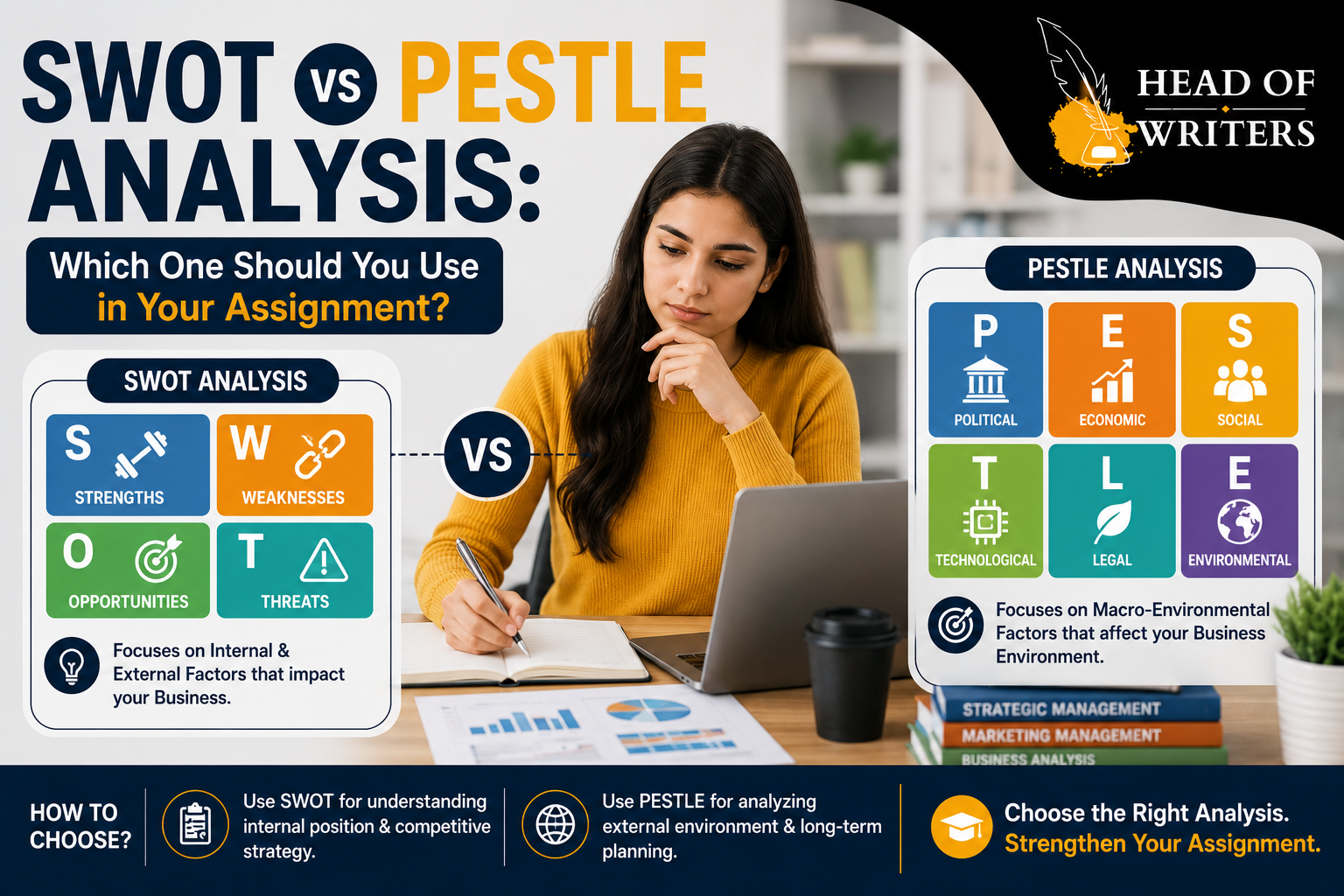
SWOT vs PESTLE Analysis: Which One Should You Use in Your Assignment?
If you’re studying business, marketing, or management at an Australian university, you’ve almost certainly been asked to “conduct a SWOT analysis” or “apply the PESTLE framework” in an assignment brief — sometimes both in the same task. They get grouped together so often that many students assume they’re interchangeable. They’re not, and picking the wrong one (or mixing them up without realising it) is one of the quickest ways to lose marks on an otherwise well-researched assignment.
This guide breaks down what each framework actually measures, when to use one over the other, how to combine them properly, and the mistakes markers see most often — so you can walk into your next case study, market report, or strategic plan knowing exactly which tool the question is asking for.
What SWOT Analysis Actually Measures
SWOT stands for Strengths, Weaknesses, Opportunities, and Threats. It’s a diagnostic tool — think of it as a health check for a specific business, brand, product, or even a personal career decision at one point in time.
The key thing that separates SWOT from PESTLE is that SWOT looks both inward and outward:
- Strengths and Weaknesses are internal — things the organisation controls (staff skills, brand reputation, cash flow, product quality).
- Opportunities and Threats are external — things happening in the market that the organisation doesn’t control but has to respond to.
Worked Example
Say your assignment asks you to evaluate a regional Australian retailer, like an independent homewares store in Adelaide expanding into online sales.
| Category | Example |
|---|---|
| Strength | Loyal local customer base built over 15 years |
| Weakness | No existing e-commerce infrastructure or digital marketing skills |
| Opportunity | Growing consumer preference for supporting local/independent brands online |
| Threat | Competition from larger national retailers with established logistics |
Notice that strengths and weaknesses are about the business itself, while opportunities and threats are about the market around it. A common mistake is putting an external factor (like “rising freight costs”) under “weakness” — that’s actually a threat, because the business doesn’t control freight pricing.
What PESTLE Analysis Actually Measures
PESTLE stands for Political, Economic, Social, Technological, Legal, and Environmental factors. Unlike SWOT, PESTLE is entirely external — it doesn’t look at the organisation at all. Instead, it maps the broader operating environment the organisation exists in.
This makes PESTLE the right tool when your assignment is about context rather than performance — industry reports, market entry analysis, or questions about how external change might affect a whole sector.
Worked Example
Imagine you’re assessing the outlook for electric vehicle (EV) adoption in Australia for a business strategy assignment:
- Political – Federal and state EV subsidies, fuel efficiency standards
- Economic – Higher upfront vehicle cost offset by lower running costs over time
- Social – Increasing consumer concern about emissions and fuel prices
- Technological – Battery range improvements, charging infrastructure rollout
- Legal – Tightening vehicle emissions regulations
- Environmental – Government carbon-reduction targets and sustainability pressure
None of these factors are about a specific company — they’re about the environment every company in that space has to operate within. That’s the core distinction to hold onto: PESTLE explains why the landscape looks the way it does; SWOT explains how well-positioned a specific business is within that landscape.
SWOT vs PESTLE: Side-by-Side Comparison
| Factor | SWOT | PESTLE |
|---|---|---|
| Focus | Internal + external | External only |
| Best for | Evaluating a specific business, brand, or decision | Understanding the broader market or industry environment |
| Time horizon | Current position, short-term | Broader trends, medium-to-long-term |
| Typical assignment types | Case studies, strategic recommendations, SWOT-based reports | Market entry analysis, industry reports, policy impact essays |
| Output | A snapshot of internal capability vs market conditions | A map of the operating environment |
Choosing the Right Framework for Your Assignment
The fastest way to decide which one you need is to look at the verb in your assignment brief.
Use SWOT when the task asks you to:
- Evaluate, assess, or diagnose a specific organisation
- Recommend a strategic direction for a business
- Compare a company against a competitor
- Analyse why a business is succeeding or struggling
Use PESTLE when the task asks you to:
- Analyse an industry, sector, or market
- Assess the impact of government policy, regulation, or technology
- Explore feasibility of entering a new market or country
- Forecast how external change might affect multiple businesses
If your brief mentions a specific company by name and asks for recommendations, that’s almost always a SWOT-driven task. If it asks about a sector or macro trend, that’s PESTLE territory.
Can You Use Both in the Same Assignment?
Yes — and for many higher-level assignments (particularly at postgraduate level or in capstone units), you’re expected to. The two frameworks complement each other well because PESTLE sets the scene and SWOT applies it to a specific business.
The correct sequence matters for markers: run PESTLE first to establish the external environment, then use those findings to inform the “Opportunities” and “Threats” section of your SWOT. This shows the marker you understand why an opportunity or threat exists, rather than just listing one without justification.
For example, in a market-entry assignment about launching a plant-based food brand in Australia, your PESTLE might reveal growing social interest in sustainability and tightening environmental regulation. Your SWOT can then use those exact points as the “Opportunity” and “Threat” — creating a report that reads as one connected argument rather than two separate lists bolted together.
Common Mistakes Students Make With These Frameworks
- Treating them as interchangeable. Using PESTLE when the brief calls for a company-specific evaluation (or vice versa) signals to the marker that you haven’t understood the tool’s purpose.
- Listing factors without analysis. A bullet point like “Technological – AI is growing” says nothing on its own. Markers want to see why it matters to this business or industry — one sentence of consequence per point is usually the difference between a pass and a credit.
- Mixing internal and external factors inside SWOT. As shown above, freight costs, interest rates, and competitor moves are external — they belong under Opportunities/Threats, never Strengths/Weaknesses.
- Running PESTLE and SWOT as disconnected sections. If they don’t reference each other, you’ve written two shorter analyses instead of one strong one.
- Skipping the “so what.” Both frameworks are diagnostic tools, not conclusions. Always follow them with a short paragraph translating the analysis into a recommendation — that’s usually where the marks are weighted.
Final Thoughts
SWOT and PESTLE solve different problems: one tells you how a business is positioned, the other tells you what’s happening around it. Once you can identify which question your assignment is actually asking, choosing the right framework — and using it well — becomes far more straightforward.
If you’re working through a business, marketing, or management task and want a second set of eyes on your structure, referencing, or argument before submission, our assignment help team can guide you through it. And if you’re not sure where to start at all, our do my assignment page walks through how our step-by-step support process works for Australian students.