AI vs Human Writers: Why Australian Universities Are Cracking Down on AI-Written Assignments
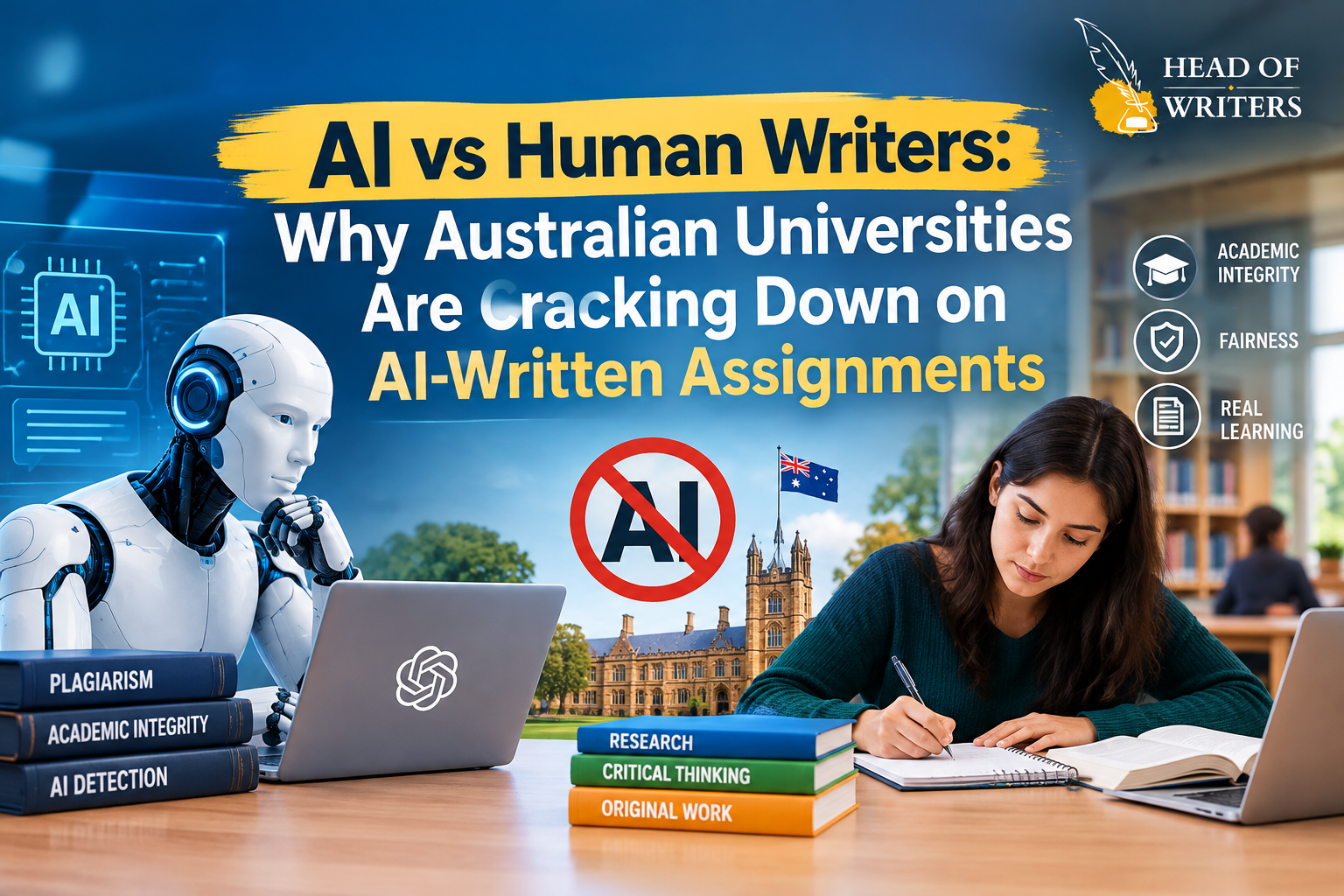
Australian universities are cracking down on AI-written assignments because AI-generated text often fails to demonstrate genuine critical thinking, misses unit-specific learning outcomes, and can be flagged by AI-detection tools now built into plagiarism-checking systems like Turnitin. In 2026, most major Australian universities treat undisclosed AI-generated submissions as a form of academic misconduct, similar to contract cheating.
If you’ve noticed your lecturers getting stricter about referencing AI use, you’re not imagining it. This shift has happened fast, and it’s changing how students need to approach their assignments — including which kind of academic support is actually safe to use.
How Turnitin’s AI Detection Works
Turnitin and similar plagiarism-checking platforms now include AI-writing detection alongside traditional similarity checks. These tools analyse writing patterns — sentence predictability, structural repetition, and statistical markers common in large language model output — to estimate the likelihood that a section of text was AI-generated.
It’s important to understand these tools aren’t perfect. They produce a probability score, not definitive proof, and false positives do happen. But universities increasingly use these scores as a trigger for further academic integrity review, which means even a flagged score — correct or not — can create real problems for a student.
Which Universities Have Tightened AI Policies
Institutions including RMIT, UTS, Monash, and Deakin have updated their academic integrity frameworks to explicitly address generative AI. Common changes include:
- Requiring students to disclose any AI tool use in a declaration or appendix
- Redesigning assessments (oral defences, in-class components, process journals) to make undisclosed AI use harder to hide
- Treating unauthorised AI use as equivalent to contract cheating under misconduct policy
Policies differ between institutions and even between units, so the safest approach is always checking your specific subject outline and assessment brief.
Risks of Submitting AI-Generated Assignments
Relying on AI tools to generate full assignment answers carries several risks beyond detection:
- Accuracy issues — AI models can generate confident-sounding but factually incorrect information, especially around Australian legislation, case law, or local industry data
- Generic content — AI output often lacks the specific, current examples markers are now explicitly looking for (industry reports, recent case studies, local context)
- Misconduct exposure — even a false-positive AI-detection flag can trigger a formal review process that costs time and stress
- Missed learning outcomes — assignments are designed to build skills you’ll need later in your course and career; outsourcing thinking entirely undermines that
Why Human Academic Writers Still Matter in 2026
Ironically, as AI detection has tightened, the value of human, subject-expert academic support has gone up rather than down. A qualified human writer or tutor can:
- Apply current, region-specific examples and legislation accurately
- Structure arguments to match a specific marking rubric, not a generic template
- Explain their reasoning so students can genuinely learn from the work
- Produce writing that reflects natural academic variation, rather than the repetitive patterns AI-detection tools are built to catch
This doesn’t mean AI tools are banned everywhere — many universities allow AI for brainstorming or grammar checking, provided it’s disclosed. The line is between using AI as a study aid versus using it to generate a full, undisclosed submission.
How to Use AI Ethically as a Study Tool (Not a Submission Tool)
If your university permits limited AI use, safe practices generally include:
- Using AI to brainstorm topic ideas or clarify a concept, then writing the actual argument yourself
- Using AI-powered grammar tools for proofreading, not content generation
- Always checking your subject’s specific AI-use policy before starting
- Disclosing any AI assistance exactly as your university requires
When in doubt, treat AI the way you’d treat any other external source: useful for understanding, not a substitute for your own analysis.
How Head of Writers Guarantees 100% Human, Original Content
At Head of Writers, every assignment is written from scratch by a qualified, subject-matter human expert — never generated by AI. Our process includes:
- Original research and writing for every order, with no AI-generated shortcuts
- A free plagiarism report so you can verify authenticity before submission
- Writers trained specifically on Australian university standards, rubrics, and referencing styles
- Direct communication with your assigned expert, so you can ask questions and genuinely understand the work
This keeps students safe from AI-detection flags while still getting expert-level academic guidance.
Frequently Asked Questions
Turnitin’s AI-detection feature can flag text with a high statistical likelihood of being AI-generated, but it produces a probability score rather than absolute proof, and false positives can occur.
Consequences depend on your specific university’s academic integrity policy, but flagged submissions are typically referred for review, which can range from a request for clarification to formal misconduct proceedings.
Many universities permit limited, disclosed AI use for tasks like brainstorming or grammar checking, but policies vary by institution and unit — always check your specific assessment guidelines first.
Want assignment support that’s 100% human-written and university-safe? Get in touch with Head of Writers or explore our subject-specific services.