
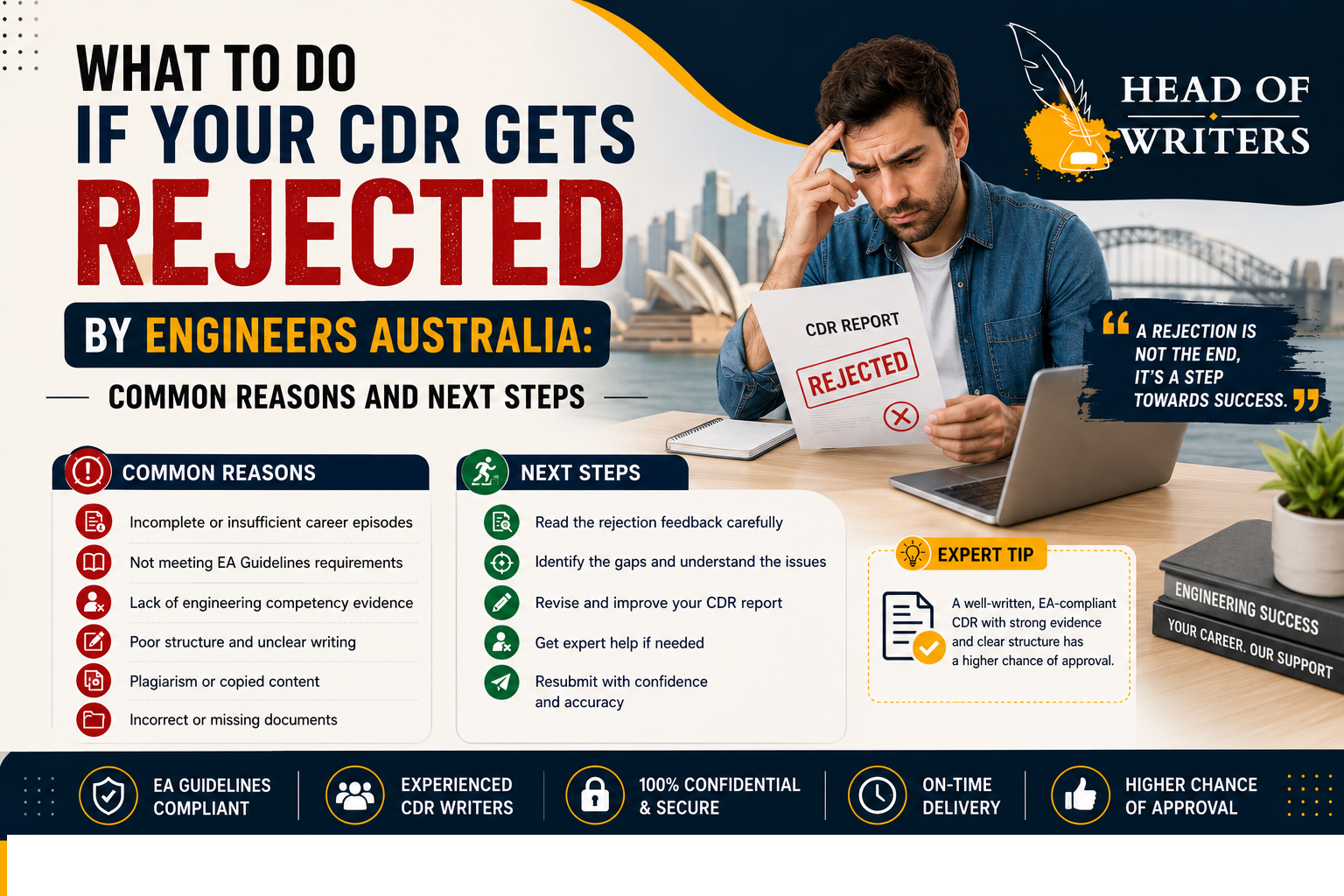
What to Do If Your CDR Gets Rejected by Engineers Australia: Common Reasons and Next Steps
Getting a rejection letter from Engineers Australia after months of preparing your CDR is genuinely disheartening. You’ve pulled together transcripts, chased old employers for references, written and rewritten your Career Episodes, and mapped your Summary Statement line by line — and then the outcome letter says it isn’t enough. If this has happened to you, take a breath first. A rejection isn’t the end of the process. It’s feedback, and it’s fixable.
This guide walks through why CDRs actually get rejected, how to interpret your outcome letter properly, and what a realistic path back to a positive assessment looks like.
First, Understand What Kind of Outcome You Received
Not every negative outcome is the same. Engineers Australia generally issues one of a few outcomes:
- A request for further information — the assessor needs clarification or additional evidence, and you’re given a window to respond.
- A negative assessment against your nominated category — your evidence didn’t meet the competency standard for that specific occupational category (Professional Engineer, Engineering Technologist, etc.).
- A negative assessment overall — the application, as submitted, didn’t demonstrate the required competencies at all.
Read your outcome letter carefully before doing anything else. Engineers Australia typically identifies which competency elements weren’t adequately demonstrated, and that detail is the single most useful piece of information you have for fixing the problem. Skimming past it and rewriting everything from scratch wastes time you don’t need to lose.
The Most Common Reasons CDRs Get Rejected
After the specifics of any individual case, most rejections trace back to a handful of recurring issues.
Weak or vague competency demonstration. Career Episodes that describe what a project was about, rather than what you personally did, engineered, decided, or solved, tend to fall short. Assessors are looking for your individual contribution and reasoning — not a project overview.
Paragraph references that don’t hold up. If your Summary Statement cites a paragraph as evidence for a competency, but that paragraph doesn’t actually demonstrate it, assessors notice. This is one of the most common — and most avoidable — reasons for rejection.
Plagiarism or template similarity. Engineers Australia runs every CDR through plagiarism detection software. Career Episodes that closely resemble template language, sample CDRs found online, or another applicant’s submission are flagged immediately, regardless of how strong the underlying experience actually is.
Mismatched occupational category. Nominating as a Professional Engineer when your actual work and qualifications sit closer to Engineering Technologist (or vice versa) means your evidence is being measured against the wrong framework from the start.
Insufficient depth on Engineering Application Ability. Many rejected CDRs lean heavily on theoretical knowledge and professional attributes but under-develop the practical, applied engineering problem-solving competencies — which is often the unit assessors scrutinise most closely.
Formatting non-compliance. Career Episodes that include tables, equations, or calculations instead of narrative explanation, or that fall outside the required word count, can be knocked back on technical grounds alone, separate from the quality of the content itself.
Reading Between the Lines of Your Outcome Letter
Engineers Australia’s feedback is often more specific than applicants initially realise. Look for:
- Which of the three competency units (Knowledge and Skill Base, Engineering Application Ability, Professional and Personal Attributes) was flagged as insufficient.
- Whether the issue was raised against a specific Career Episode or across the Summary Statement generally.
- Any explicit mention of plagiarism, formatting, or paragraph-reference concerns, which point to a fixable structural issue rather than a gap in your actual experience.
This distinction matters. A competency gap might mean you need to draw on different project experience. A referencing or formatting issue means your experience was fine — the document just didn’t present it correctly.
Your Next Steps After a Rejection
1. Request clarification if the letter is unclear. You’re entitled to understand why a decision was made. If the feedback doesn’t clearly explain which competencies weren’t met, it’s worth following up before you start rewriting.
2. Audit your Career Episodes against the correct competency elements. Go through each required element for your occupational category and check, line by line, whether your episodes actually address it — not just imply it.
3. Re-verify every Summary Statement cross-reference. Confirm each paragraph you’ve cited genuinely supports the competency claimed against it. This is a common point of failure and one of the easier ones to fix properly.
4. Run a plagiarism check before resubmitting. If similarity was flagged, or even if it wasn’t, it’s worth confirming your Career Episodes are genuinely original before you submit again.
5. Get a second, expert set of eyes on the revised draft. After staring at the same document for months, it’s genuinely difficult to spot your own gaps. A structured CDR Writers Australia review can catch exactly the kind of mismatched references, thin competency coverage, and formatting issues that assessors flag — before you resubmit, not after a second rejection.
6. Understand there’s no penalty for a well-prepared resubmission. A previous negative outcome doesn’t count against you if your resubmission genuinely addresses the gaps identified. Engineers Australia assesses what’s in front of them each time.
A Rejection Is a Correctable Setback, Not a Dead End
It’s easy to read a negative outcome as a judgement on your engineering career. It isn’t. In the overwhelming majority of cases, a CDR rejection reflects specific, identifiable gaps in how competency was demonstrated or documented — not a verdict on whether you’re a capable engineer. Engineers who take the outcome letter seriously, address the actual issues raised, and get a thorough review before resubmitting generally succeed on their second attempt.
If you’re working through a rejection right now, take it step by step: understand exactly what was flagged, fix the specific issue rather than starting over blindly, and get an expert review before you send it back. And if the rejection has thrown off other coursework or deadlines you’re juggling at the same time, our broader assignment help resources are there to help you keep the rest of your workload on track while you sort this out.

